
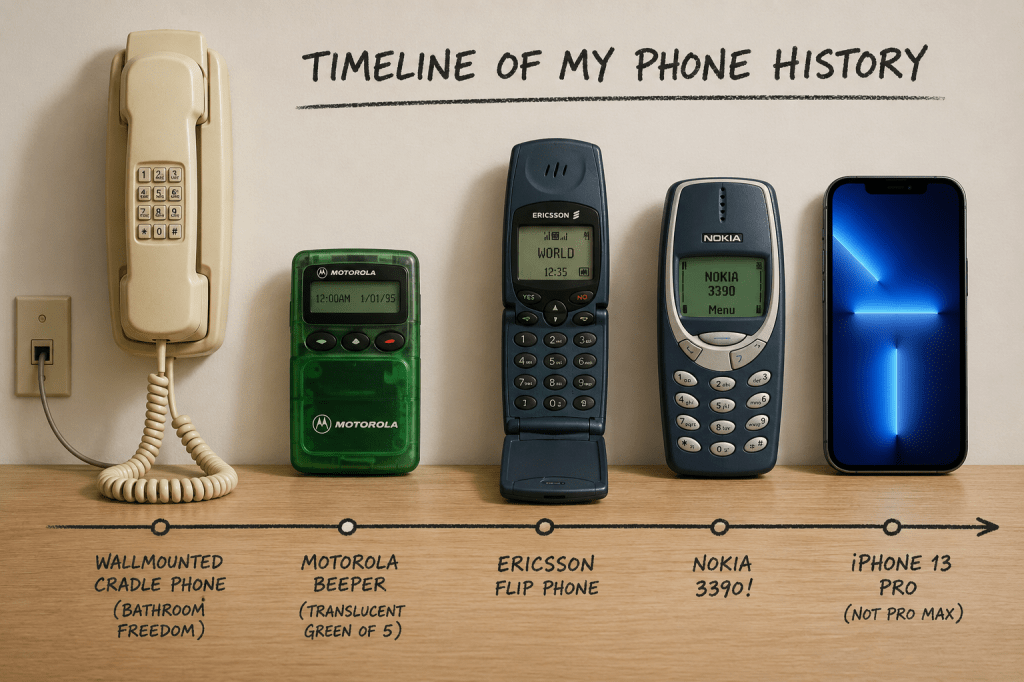
The First Number I Memorized
I still remember the first phone number I ever memorized: our home number, the one with the rotary dial that sat on the kitchen counter like a small, black monument to patience. I can recite it at a moment’s like a latent Treadstone agent: 425-778-3228. My father worked for Pacific Northwest Bell back then, right after the government broke up AT&T’s monopoly in 1984. He’d come home smelling of copper wire and central office dust, carrying stories about switches and trunk lines that I only half understood. But I understood the phone.
In 1976, the year of America’s Bicentennial and my own arrival into the world, that rotary phone was the tether between our house and everything else. I learned to dial by dragging my finger through the holes, waiting for the dial to spin back with its mechanical whir before I could move to the next digit. There was no redial button. If you got a busy signal, you hung up and tried again. If no one answered, you tried later. There was no voicemail to capture your voice, no text to leave behind. The phone demanded presence-yours and theirs, simultaneously.
My mom was a tried-and-true Filipina-American. Always a Filipino first, American citizenship second. That being the case, she would love to talk on the phone in Visayan (like a secret language understood by few) for hours on end, daily and everywhere in the house as she was also … Mom. She might as well have been 1990’s Windtalker!
My Dad was so frustrated with her phone activity that he brought home specific items, and taught me how to install it. 25 feet of line cord (from the wall to rotary phone) and 10 feet of handset cord (from the phone to the handset to talk) It was ridiculous to anyone visiting, but perfectly normal to the Bayne family. Wanted to find Mom? Follow the clearish line cord to either the laundry room, or kitchen. The loudest conversation involving a coded language was your second clue.
By the time I was a teenager, like 13 years old, I was also flirting with a newfound activity “girls”. Between my Mom and I fighting over phone use my father couldn’t use the phone that he actively pays for! It was comical.
He proposed a sweeping solution: install call-waiting on the main line and set up a separate phone line that would run directly into my bedroom.
With my paper route and lawn-mowing money, I could easily cover the costs and even start building credit since it was an utility that required my social security number. Naturally, I jumped at the chance! A teenager with my own phone and my own number? Absolutely thrilling! I envisioned late-night calls from girls without disturbing the rest of the house. My own line—a dedicated number that connected straight to my room—felt like a rite of passage, a taste of independence. But that freedom came with its own set of responsibilities: I was the one footing the bill, writing checks to Pacific Northwest Bell from the checking account I had opened just for this purpose. Those monthly payments, the checks I meticulously signed and mailed, were laying the groundwork for something I didn’t quite grasp back then: my credit history. That teenage phone line became the cornerstone of my financial journey, the initial bricks in a foundation I would rely on for years to come.
My father, ever the telephone man, brought home the first cellular phone I’d ever seen. It was a Motorola, the size of a small briefcase, with a handset that looked like it belonged in a car but somehow connected to the world through invisible signals. We weren’t supposed to touch it. It was for “business,” for emergencies, for a future that hadn’t quite arrived. But I remember holding it once, feeling the weight of possibility in my hands.
Then came the BEEPERS. My first one, a translucent teal rectangle (Clear / Crystal Transparent
Smoke Gray (A dark, see-through charcoal) Translucent Teal / Aqua Blue (Often paired with a contrasting purple belt clip, mirroring the wildly popular Charlotte Hornets color scheme of the era) Translucent Purple / Violet, Cherry Red / Translucent Crimson, Lime Green / Translucent Emerald)
… clipped to my belt in the mid-90s, buzzing with urgency whenever a number flashed on its small screen—a signal that someone needed to reach me. The ritual felt almost athletic: I would feel the buzz, quickly scan the number, and set off in search of a payphone. I became adept at spotting them—outside gas stations, tucked away in the corners of bustling restaurants, or mounted on walls in hospital lobbies. With a practiced hand, I’d dig for quarters, the cold metal slipping between my fingers as I dialed the number, heart racing, hoping the call would connect. I always carried a roll of quarters, worth ten dollars, not just for payphones but also for video arcade games, a dual purpose that made it feel like I was prepared for anything. If no one answered, the dance continued, a relentless pursuit of connection.
There were no smartphones, no instant messaging apps to bridge the gap between us and the outside world. Instead, we relied on the tactile experience of dialing, the satisfying click of the rotary mechanism as it spun back into place. Each number felt like a small victory, a connection made through the simple act of turning a dial. When I picked up the receiver, the weight of it felt reassuring in my hand, a tangible link to the voices of friends and family who lived beyond our four walls.
Conversations flowed freely, punctuated by laughter and the occasional sigh of frustration when someone couldn’t be reached. The air was thick with anticipation, each ring echoing in my ears, a promise of connection or the disappointment of silence. I learned the rhythm of waiting, the dance of patience that came with trying to reach someone who might be busy or simply not home.
In those moments, the phone was more than just a device; it was a lifeline, a bridge to friendships that blossomed over hours spent chatting about everything and nothing. I would often sit cross-legged on the living room carpet, the long cord stretching to accommodate my every movement, while I shared secrets, dreams, and the trivialities of teenage life. Those conversations, rich with emotion and the thrill of discovery, shaped my understanding of connection long before I could grasp the complexities of technology that lay ahead.
My first analog mobile phone made its grand entrance in the late 1990s, an Ericsson flip-phone that felt like I was cradling a piece of the future. I was undeniably the epitome of cool! Its evergreen green casing and flimsy telescoping antenna gave it a quirky charm. But then? Mobile phone technology took off like a rocket.
By February 2001, I simply had to have the latest and greatest for my birthday: the Nokia 3390. This little marvel boasted a game called Snake and a calculator, and it could even send text messages—if you had the patience to tap the number keys multiple times to cycle through letters. I used it to call all the girls I was trying to impress. If you were anyone worth your salt, you personalized your phone with catchy ringtones and swapped out interchangeable cases weekly, each one a fresh accessory to match that day’s outfit.
Now, at 50, I hold a smartphone that contains more computing power than the Apollo missions. I can video call my fiancée from anywhere, send instant messages that cross the globe in milliseconds, access the sum of human knowledge from my pocket. And yet, sometimes I find myself in text conversations that stretch across hours-ping, pong, ping-when a five-minute phone call would have resolved everything.
America turns 250 this year, and I turn 50. The math feels deliberate, as if the universe wanted me to witness something. I was born into a nation celebrating its 200th birthday, and now I get to see its 250th. I’ve lived through eight presidencies, from Carter to Biden. I’ve watched the Berlin Wall fall on a television with rabbit ears, celebrated the turn of the millennium in a crowd of strangers, watched the towers fall on a screen that was suddenly everywhere. I’ve seen the internet transform from a curiosity to the infrastructure of modern life.
Generation X-my generation-occupies a strange place in history. We are the bridge between analog and digital, the last generation to remember rotary phones and the first to adopt smartphones. We learned to type on manual typewriters in school, then graduated to computers. We grew up with three television channels and witnessed the explosion of streaming content. We are comfortable with both patience and instant gratification, having learned the first and adapted to the second.
This bridging quality extends to how we lead. Gen X leaders tend to be pragmatic, resourceful, and independent. We value work-life balance because we watched our parents sacrifice everything for careers that sometimes disappeared. We communicate directly because we remember when communication required effort. We embrace technology while maintaining skepticism about its promises. We are comfortable with ambiguity, having grown up in the shadow of the Cold War and come of age during economic uncertainty.
As I approach my 50th birthday alongside America’s 250th, I find myself reflecting on what it means to be a bridge. The rotary phone on my childhood kitchen counter taught me patience, the physicality of connection, the value of presence. My teenage phone line taught me responsibility and financial literacy. The beepers taught me resourcefulness, the ability to solve problems with limited tools. The analog cell phone taught me adaptability, the willingness to learn new technologies. And the smartphone-this device I now carry everywhere-teaches me daily about the paradox of connection: we are more reachable than ever, yet often less present.
I’ve built a life across these technological shifts. I navigated economic downturns, career changes, and the ordinary challenges of being alive. I’ve published three books-words that exist now in both paper and digital form, reaching readers through channels that didn’t exist when I was born.
The America I was born into in 1976 was healing from Watergate and Vietnam, celebrating its bicentennial with fireworks and optimism. The America of 2026 is different-more connected, more divided, more complex. But the through-line remains: we are still a nation of people trying to communicate across distance, trying to build bridges between where we were and where we’re going.
At 50, I find myself valuing the phone call more than I did at 40. Not the text, not the email, not the social media post-the actual call, where I can hear the other person’s voice, catch the hesitation in their breath, the warmth in their laughter. It’s inefficient by modern standards. It takes time. It requires both parties to be present simultaneously.
But that’s what the rotary phone taught me, all those years ago, when I was just a child learning to dial. Connection requires patience. It requires showing up. It requires the willingness to wait for the dial to spin back, to try again if you get a busy signal, to keep reaching out until someone answers.
America at 250 and me at 50-we’re both still learning to dial. Still trying to connect across the static. Still believing that if we keep reaching out, someone will eventually pick up on the other end.



Leave a comment