
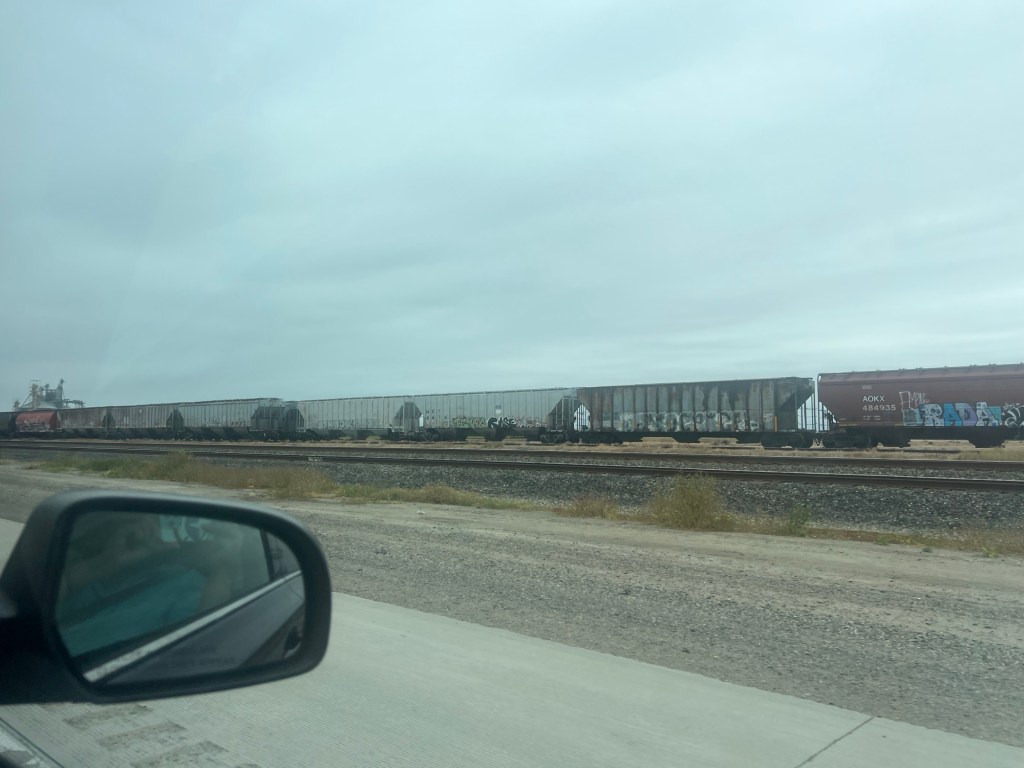
The Message I Was Sending
April 27, 2026.
Technically? It’s Morse Code Day — honoring the birthday of Samuel Morse, the man who figured out how to turn language into rhythm.
Dots.
Dashes.
Pauses.
But for me?
It marks one year since Charrina “WCP” Bayne and I loaded up the Millennium Subaru, hitched a U-Haul trailer in Tempe, Arizona, and drove 1,576 miles toward Edmonds, Washington.
Toward Jen.
The final phase of Operation: Get To Jen.
You see, in proper radio transmission you need three pieces of equipment:
A transmitter.
A receiver.
A microphone.
Simple enough, right?
Fun fact: the phrase “5 by 5” — which I have absolutely overused in the past — originates from radio operation.
World War II radio operators had two knobs on their receivers: one for loudness and one for clarity. Signal strength was rated from 1 to 5 — with 1 being weakest and 5 being strongest.
So when a transmission came through perfectly, the response was: “5 by 5.”
Perfect signal strength. Perfect clarity. Or, in modern shorthand:
Read you loud and clear.
First, a confession.
I am a licensed amateur radio operator, but I do not know Morse Code. I know. I know!
Insert dramatic gasp here.
That’s like owning LEGO and not knowing how to snap a 2×4 brick. It’s legal. It’s allowed. But spiritually? Questionable.
But here’s what I do understand. Morse Code isn’t about letters. It’s about the content. It’s about the intent. It’s about the message.
The message I wanted to send to Jen:
My intention is to be with you — by any means necessary.
Operation Get To Jen
Three phases. Because who doesn’t love an epic three-act play about love? Besides, I’m a published author, a writer, and a storyteller at heart. Of course I’m going to script something like this. To be clear — this developed organically.
Phase 1 – Who’s Going Where?
Phase 2 – When Is “the Who” Going Where?
Phase 3 – Executing the When
Early discussions of our long-distance relationship consistently included my phrase:
“We’re playing the long game, because the short game takes care of itself.”
Get it? Long dash. Dot. [Guess you had to be there.]
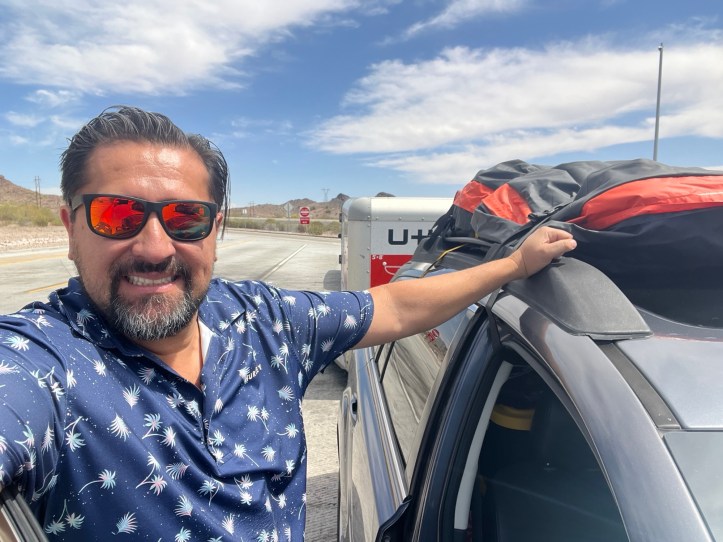
Phase 1 – Who’s going where?
Me. I’m transferring back to Washington.
Phase 2 – When is Carlos going to Jen?
April 2025.
Phase 3 – Execute the When.
Since the decision was made to load up the Millennium Subaru with a U-Haul trailer — something I had never done before — I wanted to prepare.
First off, thank you Past Los for the foresight to have a professional install a trailer hitch. And bonus points for the trailer lighting harness Jen and I installed together at the Birdcage back in July 2024.
Step one: maintenance.
After a stop at Jiffy Lube for an oil change, transmission fluid exchange, and radiator flush, the Millennium Subaru was officially cleared for duty.
Step two: research.
Hitch weight.
Load weight.
Tow limits.
Weight distribution.
Because unlike the Millennium Falcon — which somehow haphazardly “made the Kessel Run in less than twelve parsecs” in Star Wars: Episode IV – A New Hope — the Millennium Subaru would be thoroughly prepped, and the route meticulously thought out with contingency responses throughout.
I even prepared an emergency message.
Which, by the way — fun fact — S.O.S. doesn’t actually stand for “Save Our Ship.”
It was simply chosen in Morse Code because it’s easy to transmit:
• • •
— — —
• • •
Dots. Dashes. Dots.
Speaking of the route…
My coworker and friend, B-RYE, asked inquisitively which route I planned to run to get to Jen.
To which I answered:
I grumbled, “I-15 to I-84 to I-90 in March and April is treacherous as-is. Add the extra layer of complexity of hauling a trailer… nah, dawg. I’m thinking west on I-10, then north on I-5. Thoughts, Brian?”
…
We openly discussed it on the “481” dock area at Gilbert Costco. My transfer was no longer a secret — now we were preparing the team for my departure.
Literally.
He smiled in that knowing way. See, B-RYE was a transfer from Washington himself — warehouse 747, about fifteen years earlier. He knew better than to trigger my internal alarm bells with phrases like “you need to” or “you better.”
Instead, he went with a gentler approach. “Might I suggest another route that gives you easier access to resources you might need along the way — fuel, food, gasoline, tire shops, repair shops — and slower speeds?”
My curiosity was immediately piqued. “Highway 99, B-RYE?”
“Mm-hmm. That’s the one,” he nodded. “You’ll pick it up after I-10 runs out, northeast of Los Angeles.”
He continued.
“The speed limit is still around sixty, but with the traffic you won’t struggle to maintain that speed — and you can pull off whenever you want. I-5 swings out toward the coast because Highway 99 was already established as the north-south arterial. It’s efficient for trucking, but not so much for your situation.”
He paused before adding the final piece.
“The towns — cities, if you want to call them that — are sparse and spaced out. And like you mentioned from your drive down, a lot of the rest areas closed during COVID and never reopened.”
Then he shrugged. “Whatcha think?”
I smiled brightly, “I’ve always said collaborative efforts often yield better results.” Then I added the obvious conclusion. “This is fawking genius. Thank you.”
I reported back to Jen — the General at HQ anxiously awaiting an update from her soldier — that evening on my iMac during a FaceTime video call.
Jen asked lovingly, “Mi amor… what’s the plan?”
“Aiight, here’s the play. No matter what, it’s about 24 hours on the road. That’s three 8-hour shifts… or some combination of that. How we space those out depends on the bases we need.”
She nodded thoughtfully.
“Let’s plot the course and mileage,” she suggested. “Then I can book hotels in the cities where you’ll be stopping.”
I paused. Eventually I stammered, “Sure… why?”
She playfully chided me with my own words. “Why? Because collaborative efforts generally yield better results.”
My next call was to WCP — my sister. My ride-or-die choice for road rallies. The mission specialist.
I saved this call for last because I already knew the answer would be yes.
But it would be followed immediately by:
“Aiight, Big Brother… what’s the plan?”
I rarely approach her without a plan. This wasn’t FAFO — Fawk Around, Find Out. This mission was too important. It required a succinct timeline. Too many moving parts. Too many unknown variables once we hit the road.
So I kept it simple.
“WCP… go to load-out. It’s time to bring me back from Arizona desert living. You game?”
As if there was ever a question. “Of course,” she replied. “What are the vacation dates?”
“Thursday to Sunday. We’ll have you WFH by Monday,” I answered flatly.
“Copy that.” She hung up. She already knew the drill: book the flight to Arizona, send me the receipt, and I’d reimburse her. Logistics would sort themselves out.
ZERO HOUR
11:32 a.m. — Thursday, April 24, 2025.
I packed what I wanted — and what I could. Clothes. Bed. Dresser because of my LEGO sets. Everything else was sold, donated, or left behind.
It was time to pick up my “little” sister for the road rally to end all road rallies:
The Arrive Alive Drive.
The plan on paper was straightforward.
Stop One: Delano, California.
Stop Two: Medford, Oregon.
Stop Three: Edmonds, Washington.
Simple enough on paper. But we hadn’t even hit the road yet. We hooked up the trailer together — like most tasks we tackle — double-checking connections and lights. Then we pointed the Millennium Subaru west.
I appointed myself the first driving stint, considering WCP had literally stepped off a three-hour flight from Washington just hours earlier.
Oh-dark-thirty hours earlier.
Dot. Dash. Drive.
The first miles out of Tempe felt strangely quiet. We unceremoniously exited the Phoenix metro area without fanfare. Largely because I wanted this… but many of the people I left behind didn’t.
Today we were about to discover something important: How many miles can the Millennium Subaru travel between the needles of FULL and EMPTY while hauling a trailer?
Spoiler alert: It wasn’t even close to my projections.
Idiot Indicators
I don’t quite remember why, but we stopped at the Quartzsite Rest Area — westbound to switch drivers. Once we adjusted everything to WCP’s driving preferences, we hit the road again.
Mind you, we were only 2.5 hours — about 155 miles — into a 1,500-plus-mile odyssey.
After reaching freeway cruising speed, WCP delivered one of her classic verbal warnings — the kind that usually signals trouble. “Um… Los?”
“Yes?” I answered without looking up from my glowing rectangle in my hand.
WCP sheepishly asked, “What does AT OIL TEMP mean?”
I immediately sat upright in the passenger seat. “What the FAWK?” I leaned over and frowned at the dashboard. “That means Automatic Transmission Oil Temperature is out of threshold… or too hot. Since I’ve never seen that warning in the five-plus years I’ve owned this vehicle… that can’t be good.”
Ultron — my phone — was already fired up with social media apps, so I pivoted quickly to Google. Every quick search result said roughly the same thing:
Pull over soon. Turn off the engine. Let things cool down.
Four-point-seven miles later, WCP guided the Millennium Subaru into the Flying J Travel Center in Ehrenberg, Arizona.
To let the engine and transmission cool for “several minutes.” How long does that FAWKING mean exactly?At this point, the Millennium Subaru had become an aerodynamic brick flying at low altitude. I sat down in the lounge area, frustrated with myself.
Less than three hours into this operation and I was already flirting with a Chernobyl-level meltdown of my transmission. Of course it was 90 degrees outside.
- Mountainous freeway terrain.
- Heavy AF trailer.
- Windows up.
- Air conditioning blasting.
- Cruising speeds at 70 mph.
Such an idiot.
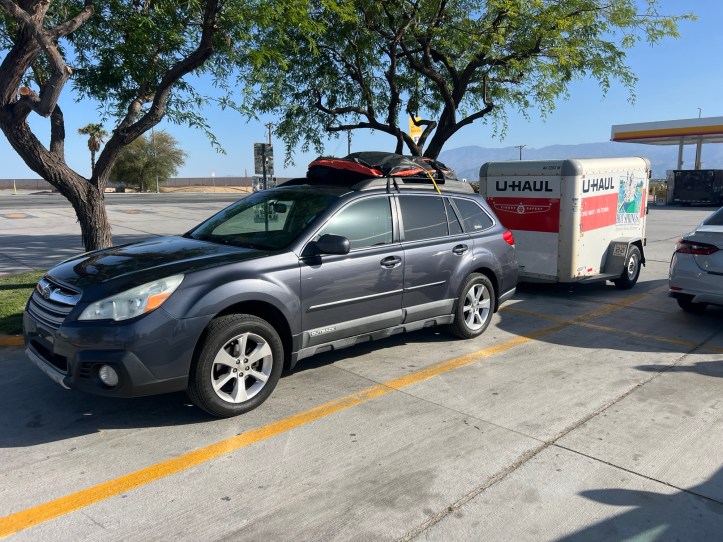
I alerted Jen about our troubles while pouting. After 30 minutes of cooling off, we tried again. The Millennium Subaru fired up with the warning light stayed off.
So we established new mission parameters:
• Air conditioning stays off.
• When necessary, turn the heater on to wick engine heat away.
• Maintain speeds between 60–65 mph.
After passing the mandatory Arizona–California fruit inspection station, we finally started settling into a rhythm. That lasted about 100 miles.
Then WCP spoke up again. “Hey Los… we’re getting low on go-go juice. What’s the plan?”
I grumbled. “Let’s pull into a Costco Gasoline station if we can.” My projected travel range per tank had been 305–310 miles. Therefore the budgeted amount of money for fuel was calculated on that number. Was it?
Not by the first pit stop. Not by the second one either. 248 miles per tank.
My gasoline budget immediately spiked.
I muttered one of my favorite quotes: “As that German general once said — no battle plan survives first contact with the enemy.” Then I added the only appropriate response. “FAWK.”
Our first overnight stop — Delano, California — suddenly felt like an unreachable oasis. And we had barely begun the drive.
The signal from the road was already clear.
Dot.
Dash.
Complication.
Thankfully, the Best Western Liberty Inn in Delano, California sat just off California State Route 99 with plenty of parking space for semi trucks, RVs, and cars hauling trailers — like us. Next door, the Denny’s was practically calling our names for a late dinner.
There was even the option of Jack in the Box, but pancakes won the evening. After we noshed, we checked in with HQ. Or at least I did.
Our electronics were charging, Ana the APAP machine was already humming along, and the room finally felt like a temporary command post instead of a pit stop.
Jen answered. “Baby, how was the road after Ehrenberg?”
“Tolerable,” I grumbling. “But we were listening for any noise out of the ordinary.”
“What time are y’all hitting the road tomorrow?” Jen pressed.
“It’ll be Friday morning. I’d like to say 08:00, maybe even 08:30. It’ll be another eight-plus-hour day to reach Medford.”
I paused before adding the strategic complication. “We’ll also be contending with Interstate 5 traffic in and around Sacramento, since that’s where Highway 99 merges into I-5.”
Jen smiled softly through the screen. “Get some sleep,” she said. “If you can.”
Dot. Dash. Dawn.
WCP and I quietly agreed that four-hour-and-change driving shifts were doable, but we also knew that 248 miles per tank came up fast. So if 248 miles came up faster than four hours, you kept driving until 4 hours.
One thing we did know for certain: she wanted me driving through Grants Pass. She loathed that stretch of road.
Since we had flown her down as the mission specialist, the request was reasonable — and easily accommodated.
That meant she would drive first, pacing things carefully so we could swap seats before my turn towing the Millennium Subaru through Grants Pass and rolling into Medford.
And thank Christ I did.
Because if we had known what was waiting for us just beyond the California–Oregon border, we would’ve switched drivers anyway.
Dash. Dot. Siskiyou.
As we hurtled toward the California-lovin’, Oregon-hatin’ border, we were approaching the eighth or ninth hour on the road.
For a multitude of reasons, we were not pacing like yesterday.
More importantly, we knew our dinner options were dwindling as we barreled into the Siskiyou Pass area.
Knock. Knock. Penny!
Knock. Knock. Penny!
Knock. Knock. Penny!
Thankfully — mercifully — Penny’s Diner was open. 4000 Siskiyou Avenue, Dunsmuir, CA.
Every bite was savory to us weary travelers. Honestly? It could have been dog food and we probably wouldn’t have cared. (To be clear, it absolutely was not. It was prepared right in front of our watering mouths by the funniest short-order cook ever.)
Our server was the quintessential 1950s diner lady — equal parts salty and sass. Her vernacular was peppered with “hon” and “sweetie,” even at that late hour.
Once fed and paid up, we felt rejuvenated.
It was time to tackle the road again for the final push into Medford.
Leaving CA / Welcome OR
Our confidence was short-lived. As we climbed toward the summit of Siskiyou Pass, late-night fog began to descend on our ascent. Shortly afterward, visibility dropped to about 50 feet — if that.
Our speed dropped to a dangerous 35 miles per hour. What followed was a white-knuckled drive I won’t soon forget — and would happily never repeat.
WCP was practically on top of the hood, guiding me with her hawk-like eyesight while I wrestled the Millennium Subaru through the fog with my battle-beaten eyes behind the wheel.
Miraculously, we weren’t slammed into from behind. At times, I simply followed red taillights disappearing into the fog. Other times, I tracked the white fog line on the right side of the road.
And somehow… Didn’t crash.
I kept the rubber side down and the shiny side up.
To cap off this eerie horror-movie mountain-pass drive, we arrived in Medford under steady rain. Pulling into the Best Western Horizon Inn — next to a Black Bear Diner — turned out to be its own challenge.
We had to perform two U-turns with the trailer before successfully lining up for the parking lot. A maneuver that probably would not have happened in daylight. But at that point?
We were simply grateful to be off the mountain.
Dash. Dash. Dash. Edmonds.
WCP and I woke up exhausted yet elated. The final phase of the trip. We were so damn close to the finish, yet still hours away from completing it. I needed breakfast before battling Grants Pass, where I knew my front brakes would be used and abused, since the trailer didn’t have any brakes of its own.
Then there was the looming chaos of downtown Portland on a Saturday — variable speed zones and what I affectionately call TRAFFUCK.
Just thinking about it made me want to HULK OUT.
But I reassured WCP. Truthfully, I was reassuring myself.
We both knew what the mission was today. Eyes on the prize.
The JW Bayne was still waiting for us to arrive.
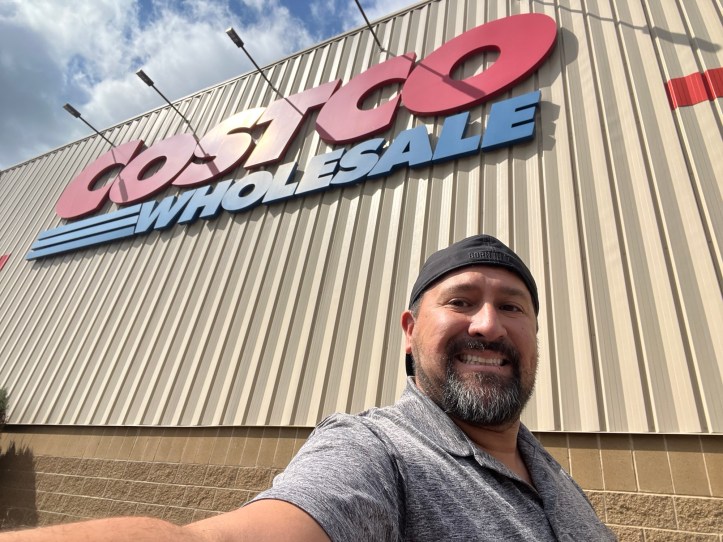
Our final fuel stop came in Vancouver at the Costco Wholesale gasoline station. It was midday, which meant it was also time for lunch. Enter Panda Express.
Fuel for both the Millennium Subaru… and the crew.
Then it was time to flatten the throttle against the plastic floor mat and finish the mission!
Once we arrived in Edmonds, everything became a blur. Jen. Her son Mehki. Mehki’s bro, JD. Everyone poured out to help unload the trailer and the Millennium Subaru. In fact, the operation went so quickly that we were able to return the U-Haul trailer the same evening before the rental office closed.
Mission logistics: complete.
The coup de grâce? That Saturday evening I finally got to chillax, crack open a brew, and watch Seattle Sounders FC take on the Colorado Rapids in Colorado on the tube.
After 1,576 miles… The signal had finally reached its destination.
In Morse Code, a signal isn’t measured by how fast it travels. It’s measured by whether it’s received and understood.
Dot.
Dash.
Pause.
Across 1,576 miles of desert heat, mountain fog, mechanical anxiety, and late-night diners, WCP and I kept transmitting the same message northward.
Arrive alive.
And at the end of that long transmission — standing in Edmonds with Jen waiting at the doorway — the signal finally came through five by five.
Loud.
Clear.
Home.


Leave a Reply