May 18, 2025 marks the 45th anniversary of the eruption of Mount St. Helens. A significant portion of the 540 million tons of ash that spewed from the volcano settled across Central and Eastern Washington, and inventive ceramists in the region collected the ash to make beautiful glazes.
I vaguely remember the actual day as a 4 year old, but here is my account …
Mount St Helens
Mount St. Helens (known as Lawetlat’la to the indigenous Cowlitz people, and Loowit or Louwala-Clough to the Klickitat) is an active stratovolcano located in Skamania County, Washington, in the Pacific Northwest region of the United States. It is 50 miles (80 km) northeast of Portland, Oregon and 96 miles (154 km) south of Seattle, Washington. Mount St. Helens takes its English name from the British diplomat Lord St Helens, a friend of explorer George Vancouver who made a survey of the area in the late 18th century.[1] The volcano is located in the Cascade Range and is part of the Cascade Volcanic Arc, a segment of the Pacific Ring of Fire that includes over 160 active volcanoes. This volcano is well known for its ash explosions and pyroclastic flows.
~ Wikipedia
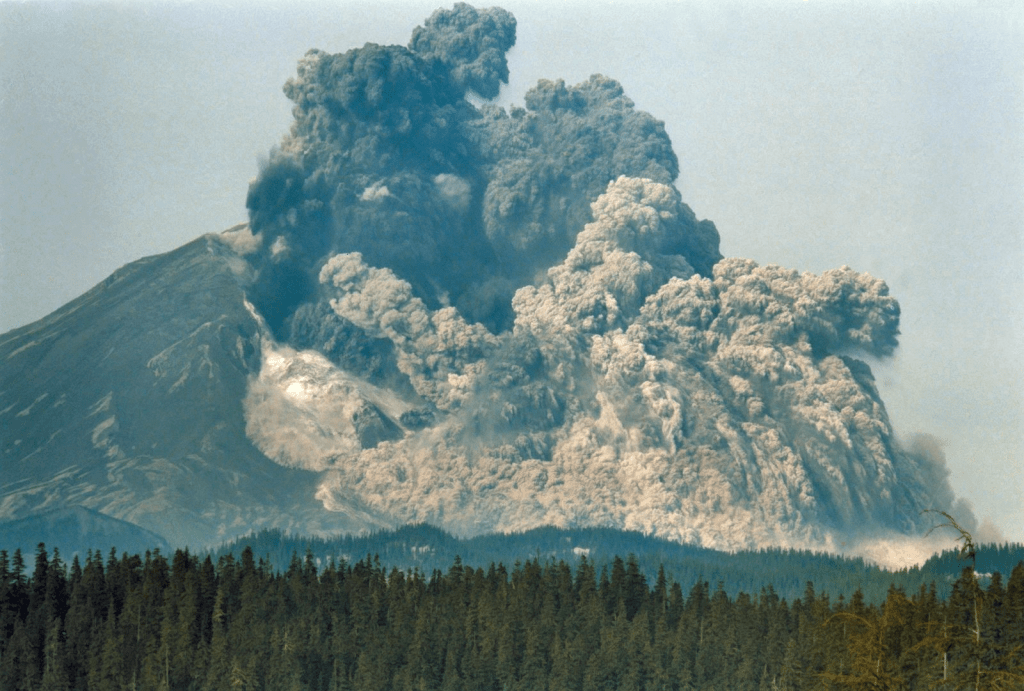
Mount St. Helens is most notorious for its major eruption on May 18, 1980, the deadliest and most economically destructive volcanic event in U.S. history! Fifty-seven people were killed; 250 homes, 47 bridges, 15 miles (24 km) of railways, and 185 miles (298 km) of highway were destroyed. A massive debris avalanche, triggered by an earthquake of magnitude 5.1, caused a lateral eruption that reduced the elevation of the mountain’s summit from 9,677 ft (2,950 m) to 8,363 ft (2,549 m), leaving a 1 mile (1.6 km) wide horseshoe-shaped crater. The debris avalanche was up to 0.7 cubic miles (2.9 km3) in volume. The Mount St. Helens National Volcanic Monument was created to preserve the volcano and allow for the eruption’s aftermath to be scientifically studied.
I remember watching the live news being broadcast from miles away on our console TV with my Mom’s knitted green and white runner with the silver and black cable box that had one dial in center of it.
The reporters warned us of volcanic ash falling from the sky like snow. Of course, I went directly outside to confirm, and to witness this phenomenon. A thin layer of grey ash was on everything I could see. It was on our emerald green Datsun B210, the lawn the roof, anywhere I surveyed with my eyes.
Since I was out there, my Dad and collected some of the ash in glass vials and jars. I wondered for years why we collected, or why he kept it. As a precautionary measure, Washingtonians were encouraged to stay inside.
Sound familiar?
At any rate, that is my recollection of that particular historic event. The following is what to expect for the week.
Anniversary Activities:
- Volcano Awareness Month:Washington State is observing Volcano Awareness Month in May, with events including lectures, movie screenings, and online discussions.
- Science and Learning Center at Coldwater:The center is scheduled to re-open on May 17th and will be a key location for learning about Mount St. Helens and its eruption.
- Johnston Ridge Observatory:While the observatory and Highway 504 at Mile Post 45.2 are currently closed due to a landslide, they are expected to be open for visitors again in 2027.
- Mount St. Helens Visitor Center:The visitor center is temporarily closed but is expected to reopen in 2027, with the road open to milepost 45 year-round.
- Events and Activities:Various events and activities are planned, including educational programs, discussions with experts, and opportunities to learn about the eruption and its aftermath.
- Commemoration and Flatware Program at the Art Museum: Washington State University is organizing a program with plates created using Mt. St. Helens ash glazes, alongside an exhibition on art and food.
Were you alive for the eruption? What was your experience? What will you do to recognize this significant date in Washington State History?

 los, Fil-Am Renaissance Man