January 7, 2025 – L.A. area wildfires were not on anyone’s Bingo Card for the month, and year! As of this writing, Saturday January 18 – yes, 11 days later, 7 of the 9 wildfires are 100% contained. Containment does not translate to not burning! It means firefighters have created and maintained a control line around the perimeter of the fire to prevent it from spreading.
That’s the simplest explanation to offer.

Multiple major wildfires are leaving a trail of destruction and death in the Los Angeles area.
A handful of wildfires that kicked up on Jan. 7, powered by high winds and dry conditions, have exploded in size. As of Thursday afternoon, 25 people had been killed and more than 12,000 buildings and structures have been destroyed. More than 160,000 people are under evacuation orders and warnings.
By Kierra Frazier, Kiki Intarasuwan, CBS NEWS
Palisades and Eaton Fires
The remaining 2 fires: Palisades, Eaton – are not contained because of their immense size! Eaton is 65% contained (updated January 18, 2025, @ 4:02 a.m.) Palisades is 35% contained. Just how big is the [Pacific] Palisades Fire, you ask?
Palisades Fire has burned 23,000 acres, or 37 SQUARE MILES! For perspective, below are maps of cities I’ve lived in with the fire map superimposed.
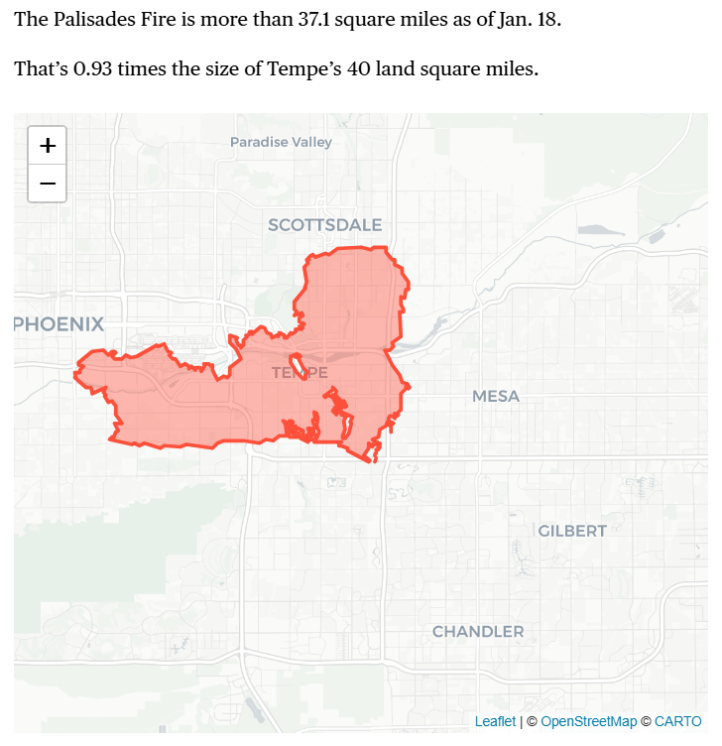
Or … let’s compare my previous city I lived in, Lake Stevens, WA.

Again, from the Everett waterfront on Puget Sound, across several rivers, Interstate 5, Washington Highway 2 bridge through ALL of Lake Stevens out to Snohomish River would be swallowed in flames!
A natural disaster of that size, and scope, it’s difficult for my mind to even imagine. With evacuation orders being issued to more than 160,000 residents, it got me thinking: how prepared am I to evacuate? Do I have a sufficient ‘bug out bag‘?
What’s a ‘bug out bag’, you ask?
Bug Out Bag
A bag, kit, or vest that a person carries on or near their person, in the event of a natural disaster such as a wildfire, civil uprising, war, or any other event that dictates that you leave the area ASAP. These bags typically contain survival gear, food, water, weapons, etc.
I asked Principal Jen on a FaceTime Call, “Do you have a bug out bag? Or emergency evacuation bag?”
She answered flatly, “No, I do not.”
I pursed my lips in my acknowledgement, “I understand. I do not have one here in the Tempe area, but I did have one in my home in Lake Stevens, WA.”
In the wake of the L.A. County Wildfires, I will create a bug out bag so I DO have one if I ever encounter an evac order that means it’s “ass and heels time” (as my Dad would affectionately call it)
That said, you, my dear reader, should too!
Despite what survivalist says to me, everyone’s bug out bag will be different based on 1) region they live in 2) access to resources and 3) personal preference. However, I do agree with an overarching idea: be prepared! Be prepared to be self-sufficient for a minimum of 72-hours!
There is plenty of information out there to build a bug out bag suited for your needs. I haven’t re-built mine but I know as an Eagle Scout, it’ll have the BSA 10 Essentials, my handheld radio (I really should figure out other methods to charging it, though) and other personal effects.
What would be in your bug out bag, Spaceship Earth? Comment below!

 los, Fil-Am Renaissance Man