This is a story-within-a-story of the family trip to the Philippines in the summer of 1997. It’s a story of cultural crossroads of the United States of America and Philippines. Actually it’s more like ‘culture shock’ than anything.
To fully appreciate the following story, you’ll need some background information. My mom hailed from Villa Jacinta on the island of Leyte in the Philippines. It’s a small village that is divided by a plateau: Lower and Upper Villa Jacinta.
When she left with an American serviceman, the village included her parents, warned her against doing so. Then again, my mom was as stubborn as my dad so she did what she wanted, when she wanted, and for however long she wanted.
Then?
When she was clearly successful in the United States, she was promoted from the black sheep to the First Daughter of Villa Jacinta. How about that?! However, she didn’t tell us any of this to prepare the family for the first memorable trip to the Philippines [My sister, and I were flown there when we were infants so no recollection of it]
Summer 1997
Our small family of four was as prepared to travel to a 3rd World Country as it could be. The “internet” was not as robust with travel information back then. And we relied on some outdated information from Mom.
The travel time to our destination was odyssey qualifying. We used jet planes, high speed catamarans, and finally Jeepneys.
What’s a Jeepney, you ask?
Jeepneys (Tagalog: [ˈdʒipnɪ]), sometimes called jeeps (Tagalog: [ˈdʒip]), are public utility vehicles, serving as the most popular means of public transportation in the Philippines.[1] They are known for their crowded seating and kitsch decorations, which have become a widespread symbol of Philippine culture and art.[2]
Jeepneys originate from the American colonial period share taxis known as auto calesas, commonly shortened to “AC”. These evolved to modified imported cars with attached carriages in the 1930s which served as a cheap passenger utility vehicles in Manila. These vehicles were mostly destroyed in World War II. The need for replacement transport vehicles led to the use of U.S. military jeeps left over from the war, which became the template for the modern jeepney.[5] The word “jeepney” is a portmanteau of post-World War II “jeep” and pre-war “jitney“, both words common slang in the popular vernacular of the era.[6][7][3][8]
~ Wikipedia
As we slowed our roll to the entrance of Villa Jacinta the entire village met us, and crowded all four sides. All the hands rapping slightly against the slow moving metal beast carrying precious cargo. They chanted, “Americanos!!” repeatedly.
Once the dust settled, and we were moderately unpacked, I surveyed the landscape. My grandparents literally had a dirt floor, because they were dirt poor. Nothing to be ashamed about, just observation. Mom said that grandpa was a banana farmer. So why the hell does he have 3 roosters in coops and a small pig tethered to a post?
My Uncle, Felimon Muldez Jr, or Junior for short was more than happy to demonstrate the fighting roosters. These were his Top 3 prized roosters. That was something I could’ve done without my entire life, and still been happy.
“What’s up with the pig, Uncle?” I mused. “Grandpa isn’t that type of farmer.”
He winked, “You’ll soon find out.”
Shortly after his answer landed on my ears, Charrina came bounding out of the house with a jubilant, “LOOK, LOS! Mr. Oinks!”
I side-eyed Junior immediately. What did he mean?
The Harvest Queen of Macrohon
When we arrived in the summer, Villa Jacinta was gearing up for the Harvest Queen of Macrohon Festival. I read a handwritten, and handcrafted signage advertising the festival, complete with buffet dinner and lechon.
I knew exactly what my uncle meant. *sigh* Charrina is not gonna like this.
What’s lechon, or rather lechón, you ask?
Lechón comprises a whole pig spit-roasted over charcoal and flavored with oil and spices. It’s a dish typically served to celebrate special occasions — Filipino birthday parties and Christmas dinners often have a lechón or two on the menu.
OR at the Harvest Queen of Macrohon Festival where the American celebrities will be attending and be guest judges to be put on display …
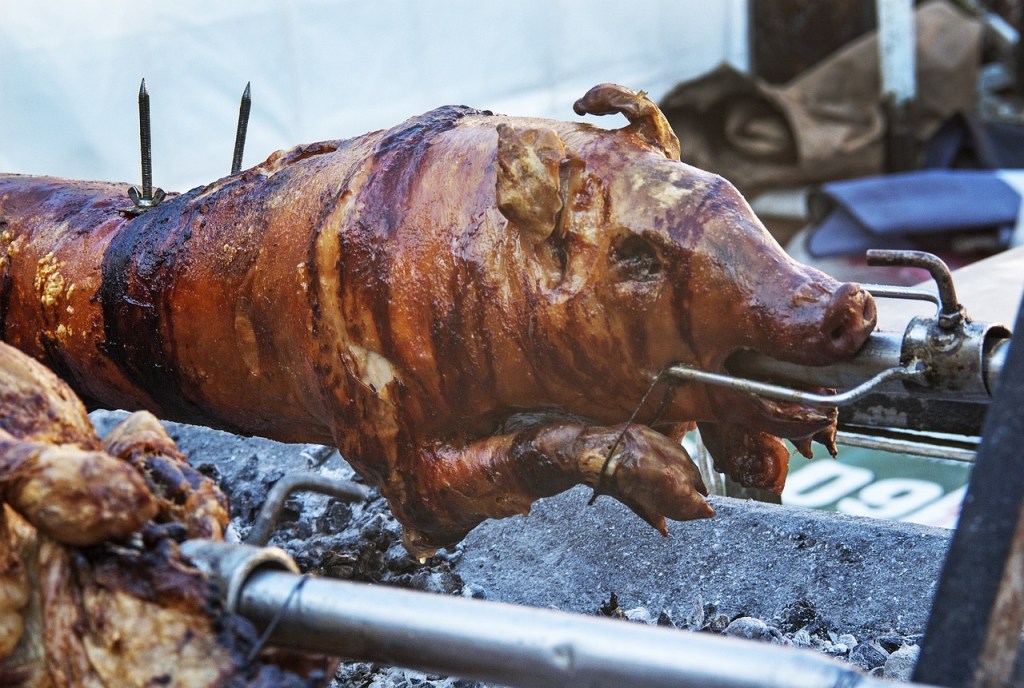
A couple of days into our visit, I woke up and discovered that the Mr. Oinks was gone, but so was everyone else. There’s a scene in the movie, Forgetting Sarah Marshall (2008), when the main character is invited to prepare the pig for the luau.
Well … my Dad was invited to help prepare the pig for the festival. Not only that, he filmed the ordeal with a VHS Recorder Camera.
On the morning of the festival’s coronation night, Charrina asked where was Mr. Oinks. I played it off, as perhaps he was transported to eat or another farm. Knowing damn well, that he was being prepared to be cooked.
That night, during the buffet, like any big brother would remark as my arm swept across the tables in front of us, “Mr. Oinks is everywhere now, from farm to table.”

 los, Fil-Am Renaissance Man